

Managing water infrastructure across one of Australia’s fastest-growing regions is no small task. From responding to burst water mains to protecting vulnerable customers during service interruptions, effective operations depend on having the right information, available to the right people, at the right time.
For Greater Western Water (GWW), Formbird CLARITY brings together asset information, workforce management, field operations and customer impact data to support the delivery of essential water services.
Supporting a growing Melbourne
Greater Western Water provides drinking water, recycled water, sewerage and trade waste services across Melbourne’s central and western regions.
According to its 2024–25 Annual Report, GWW services a population approaching 1.5 million people, with 598,828 residential connections and 55,267 non-residential connections across approximately 3,700 square kilometres.
Its infrastructure includes an asset base valued at approximately $4 billion, covering water supply networks, treatment facilities, pumping stations and other essential infrastructure.
With the region’s population expected to almost double over the next 30 years, efficient asset and workforce management will become increasingly important.
Bringing water operations together in one system
Greater Western Water uses Formbird CLARITY as a mobile workforce and operational asset management solution, integrating information from its internal property and Geographic Information System (GIS) databases.
Rather than requiring staff to consult multiple disconnected systems, CLARITY provides a central operational view of assets, properties, customers and scheduled activities.
The system supports a wide range of business processes, including:
- Customer call-taking and works dispatch
- Reactive maintenance and emergency response
- Preventive maintenance and project works scheduling
- Before You Dig requests
- Above-ground and below-ground asset management
- Asset condition inspections and documentation
- Workforce allocation and contractor coordination
- Labour, materials, activities and consumption recording
- Customer impact assessment and water supply interruptions
- Occupational health and safety processes, including confined space entry and traffic management
By bringing these processes together, GWW can coordinate day-to-day maintenance alongside more complex operational projects.
From identifying a problem to getting the job done
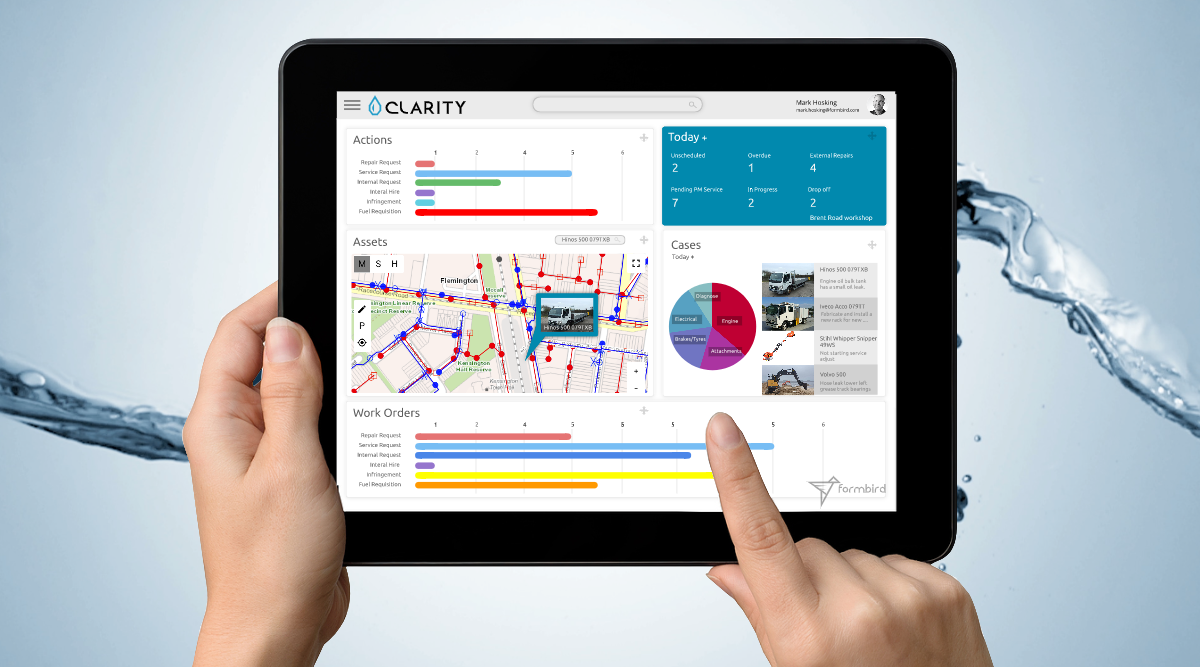
At the heart of CLARITY is a practical system for organising work through Cases and Actions.
A Case represents an operational requirement, whether it is a reported fault, an urgent repair or a planned maintenance activity.
Cases can be categorised according to their type, priority, infrastructure location and potential customer impact.
Each Case contains one or more Actions representing the activities required to complete the work.
For example, a water main repair might involve isolating the water supply, inspecting the damaged infrastructure, arranging traffic management, completing repairs and reinstating the affected area.
CLARITY allows these Actions to be assigned to appropriate employees, teams or external contractors, with progress recorded as work proceeds.
This gives works administrators, supervisors and field crews a consistent view of what has been completed, what remains outstanding and who is responsible for the next step.
Using GIS integration to protect vulnerable customers
One of the most valuable applications of Formbird CLARITY at Greater Western Water is its ability to connect operational works with their potential impact on customers.
When a water supply interruption is planned or an unexpected fault occurs, integrated GIS information helps identify the affected network, surrounding properties and customers who may require special consideration.
This is particularly important for people who depend on a continuous water supply for medical reasons, including customers receiving dialysis treatment at home.
Earlier operational processes required staff to consult separate GIS applications and manually maintained spreadsheets to identify critical locations and properties with repeated supply interruptions.
Formbird CLARITY brought this information into the operational workflow.
Affected properties can be displayed on a map, with critical locations and special requirements highlighted for call-taking staff, works administrators and field crews.
The system also supports tracking properties that have experienced repeated disruptions, helping staff identify potential Guaranteed Service Level obligations.
After work is completed, actual customer impacts can be recorded, providing information for future planning and reporting.
This is where effective asset management becomes more than an operational efficiency exercise. It becomes a way of helping protect the people who depend on essential services.
Less administration, more time for essential work
Water utilities generate significant amounts of operational information. Every inspection, repair, maintenance activity and customer interruption may require records for operational, financial or regulatory purposes.
CLARITY enables staff to record work activities and track their progress within the same system used to manage the work.
This reduces dependence on manual spreadsheets and duplicated data entry while improving the availability of information for reporting and operational decisions.
In an earlier Formbird project update, productivity enhancements at Greater Western Water were expected to reduce administrative workload by the equivalent of at least one full-time position, with a longer-term target equivalent to three positions as the improvement project progressed.
These were projected administrative efficiency gains rather than a claim of reduced staffing, but they demonstrate the potential value of removing repetitive administrative tasks.
Additional enhancements have included bulk processing activities, supervisor review workflows and works administration reporting.
Supporting safety and regulatory reporting
Managing water infrastructure means managing risk.
Field crews may encounter confined spaces, abnormal electrical voltages, traffic hazards, challenging site conditions and potentially aggressive behaviour.
Formbird CLARITY supports the recording and management of these operational hazards, allowing relevant safety information to be incorporated into work planning and field activities.
The system also supports the structured collection of operational performance information required for regulatory reporting.
Victorian water utilities report against service standards and performance measures overseen by the Essential Services Commission (ESC).
By maintaining consistent records of incidents, work activities, customer impacts and resolution times, CLARITY helps GWW assemble operational information needed for reporting, performance analysis and continuous improvement.
Built to evolve as operational needs change
An important part of the Formbird approach is that organisations are not locked into a rigid, one-size-fits-all application.
Formbird CLARITY is built on the Formbird low-code platform, allowing business workflows, forms, rules and reporting to be configured as operational requirements evolve.
The platform supports mobile working, including functionality designed for environments where internet connectivity is unreliable or unavailable.
The relationship with Greater Western Water also has a history of continuous improvement.
Before GWW was formed in 2021 through the integration of City West Water and Western Water, City West Water had already implemented enterprise works management using the Formbird platform.
Its original implementation was completed in approximately nine months, followed by nine further upgrades over an 18-month period.
That approach demonstrates an important principle of successful digital transformation: business systems should continue to evolve alongside the organisations using them.
Better information, better decisions, better service
For Greater Western Water, the value of Formbird CLARITY extends beyond individual maintenance jobs.
The integration of asset information, customer records, field activities and operational reporting supports a more connected approach to managing essential infrastructure.
Supervisors can monitor outstanding work, field crews can access relevant information, administrators can coordinate resources, and managers can use recorded operational data to identify opportunities for improvement.
Most importantly, the system helps put customer impacts and workforce safety at the centre of operational decision-making.
As Greater Western Water continues to serve a growing population across Melbourne’s west, adaptable technology will remain an important part of delivering reliable and responsive water services.
Formbird CLARITY demonstrates how integrated asset and workforce management can turn complex operational information into practical, everyday decisions — helping water utilities keep their networks, their people and their communities flowing.
Discover Formbird CLARITY
Formbird CLARITY is a configurable enterprise works and asset management solution developed for the complex requirements of water utilities and other infrastructure organisations.
From mobile field operations to planned maintenance, customer impact management and operational reporting, CLARITY connects the information and people needed to get work done.
Explore Formbird CLARITY and its capabilities
